
Evergrow Organic Fertilizer
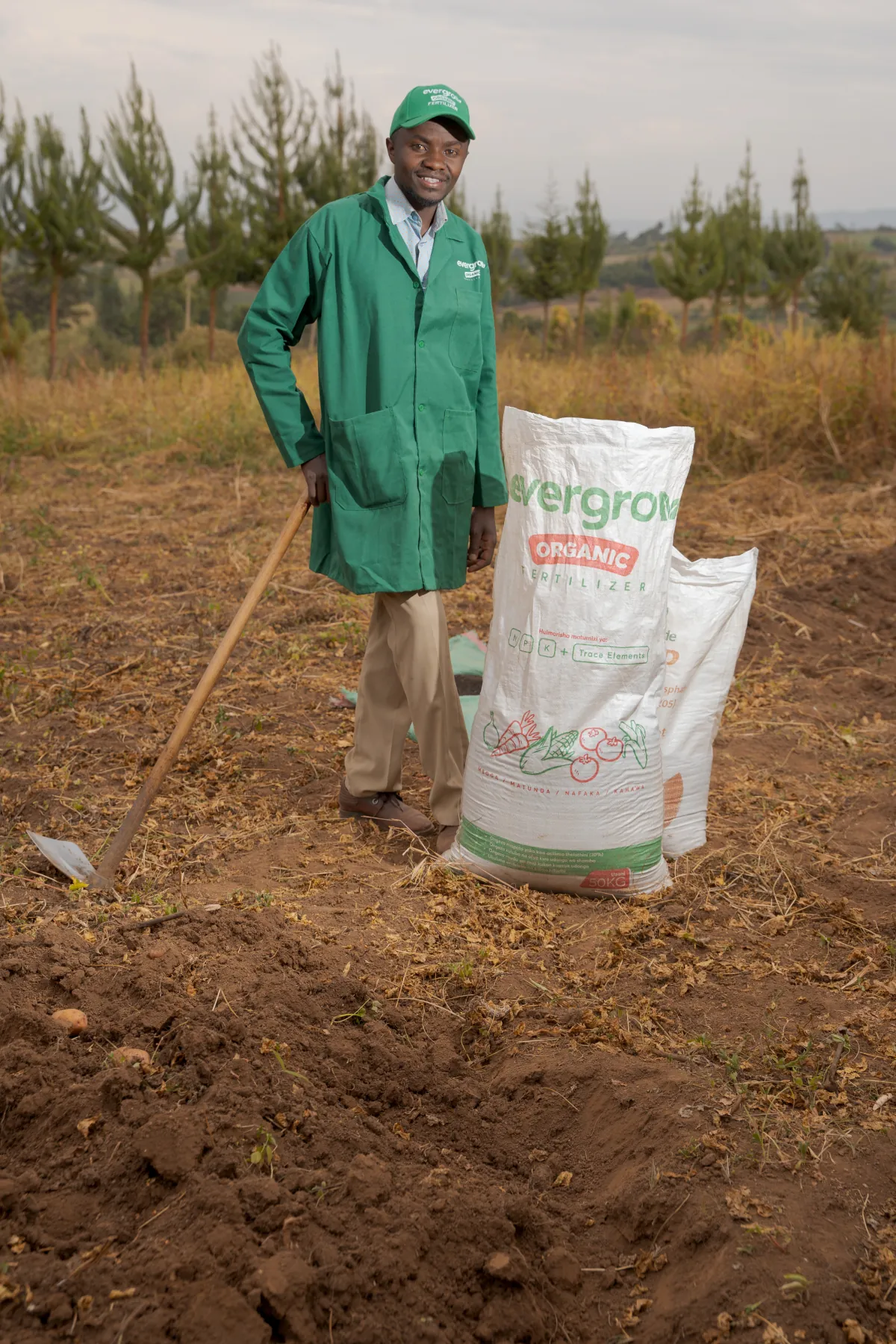
Regen Organics produces Evergrow, a nutrient-rich organic fertilizer made from agricultural, animal, and municipal organic waste.
Regen Organics produces Evergrow, a nutrient-rich organic fertilizer made from agricultural, animal, and municipal organic waste.
Kenya
Horticulture Crops
Increased Farmer Income

Impact Highlights
10,000+
10,000+
10,000+
Farmers reached
47%
47%
47%
Of Evergrow users are women
217%
217%
217%
Average self-reported revenue increase
Summary
Practice snapshot
Practice
Evergrow, a thermophilic co-composted organic fertilizer made from agricultural, animal, and municipal organic waste
Implemention Organization
Regen Organics
Geography
Kenya
Crops / Value Chain

Horticulture Crops

Luxury Crops

Grains & Cereals

Sugar Crops

Tubers

Fruit Trees
Adoption & outcomes
Farmers Adoption
10,000+
through the Farmstar distribution channel, with the reseller/agro-dealer network (500+ agro-dealers) extending well beyond that figure
Core Outcomes

Increased Farmer Income

Climate Impact

Improved Soil Health
Land Tenure
Land Tenure

99% of surveyed users describe their role as farm owner (60 Decibels survey, n=287)
Gender Participation
Gender Participation

47% of surveyed Evergrow users are women
Date Submitted
August 2026
How to Adopt
Pair with inorganic fertilizer at first
Pair with inorganic fertilizer at first
Introduce Evergrow alongside farmers' existing chemical fertilizer use to ease the transition; an independent study found 42% of users go on to stop inorganic fertilizer entirely (60dB).
Introduce Evergrow alongside farmers' existing chemical fertilizer use to ease the transition; an independent study found 42% of users go on to stop inorganic fertilizer entirely (60dB).
Apply as a basal or in-row dressing
Apply as a basal or in-row dressing
Apply at the recommended rate of 500kg (ten 50kg bags) per acre — 1.3 metric tonnes per hectare — adjusted to soil test and crop needs.
Apply at the recommended rate of 500kg (ten 50kg bags) per acre — 1.3 metric tonnes per hectare — adjusted to soil test and crop needs.
Source through a local agro-dealer or rep visit
Source through a local agro-dealer or rep visit
Access via the agro-dealer/reseller network, an NCPB depot, or a direct farm demonstration — the channels farmers report as most trustworthy.
Access via the agro-dealer/reseller network, an NCPB depot, or a direct farm demonstration — the channels farmers report as most trustworthy.
Budget for a higher upfront cost
Budget for a higher upfront cost
Evergrow costs more out of pocket than subsidized inorganic fertilizer (roughly KSh 25,000 per acre); plan cash flow accordingly, especially given the current 50kg-only pack size.
Evergrow costs more out of pocket than subsidized inorganic fertilizer (roughly KSh 25,000 per acre); plan cash flow accordingly, especially given the current 50kg-only pack size.
Track yield and income over at least one season
Track yield and income over at least one season
Most farmers report an effect within the same season or within a year of first use.
Most farmers report an effect within the same season or within a year of first use.
Key Takeaways
Recommendations
To ease initial adoption, position organic fertilizer as a complement to inorganic fertilizer, not a full replacement — 88% of users had used only inorganic fertilizer before Evergrow, and many later reduce or stop it once trust is built.
Invest in direct representative visits and farm demonstrations. 62% of surveyed farmers were trained this way, with 92% satisfied or very satisfied — by far the highest-reach, highest-satisfaction channel.
Build and publish independent third-party evidence. In a market where most competing organic products have no data behind them, Regen Organics points to its three independent evaluations as what turns a first purchase into a repeat one.
Pursue government and county partnerships — certification, depot access, and county-level voucher pilots — to offset the absence of a national organic-fertilizer subsidy.
Keep the product physically close to farmers. Transport cost is a real barrier for a bulky organic input, and adoption is strongest near the agro-dealer and Farmstar network.
Pitfalls to avoid
Underestimating price sensitivity when competing directly against a subsidized synthetic product sold below its true cost.
Assuming one pack size fits all farm sizes — a 50kg-only bag is, in Regen Organics’ own words, the most consistent complaint in farmer feedback: a cash-flow hurdle and more product than many small-plot farmers need at once.
Overstating attribution of income gains to the product alone — only ~37% of reported income gains are attributable to Evergrow itself once weather and price effects are accounted for.
Reading a challenge statistic without checking its base. The 19% of surveyed farmers who report any challenge at all break down into 32% citing price and 26% citing poor outcomes — shares of that smaller group, not of every farmer surveyed.
Repackaging a certified product into smaller units without a plan to protect certification integrity — informal repacking risks undermining the exact trust that KEBS certification is meant to provide.
Economics Snapshot
Key financial metrics
Cost to implement
~KSh 65,000
per hectare (26 × 50kg bags at KSh 2,500/bag)
Farmer income gain
217%
average self-reported revenue increase (91% median); ~37% attributed to Evergrow
Farmer Perspective
“
I highly recommend Evergrow. It keeps the crops strong even when the rain fails.
Patricia Wathua Njoroge, potato farmer, Nakuru County
“
I wanted to farm in an expert way. Now, even with the rains, I see the benefits in the health of my harvest.
Regina Salim, potato farmer, Mosop Molo
The complete, detailed story behind this practice
The complete, detailed story behind this practice
Full Case Study
Full Case Study
Problem & Baseline
Targeted Agricultural Problem
More than 65% of Kenya's arable soils are depleted, according to a study conducted with Precision Development, driven by decades of inorganic-fertilizer-only farming across Kenya and the wider sub-Saharan Africa region. Evergrow was developed to help farmers rebuild soil fertility and improve yields without asking them to abandon synthetic fertilizer outright.
Baseline Farm Conditions and Practices
88% of Evergrow customers report having used only inorganic fertilizer before adopting it (60 Decibels, n=287) — for most of Regen Organics' customer base, Evergrow is their first interaction with any organic fertilizer.
Historical System Barriers to Adoption
Two structural barriers dominate. The first is supply-chain fragility: Kenya imports almost all of its inorganic fertilizer through some of the most exposed choke points in global trade, and a February 2026 conflict in the Strait of Hormuz cut off roughly a third of the country's fertilizer supply right at the start of the planting season — a shock Evergrow was not exposed to, since it is manufactured locally from local waste. The second is an uneven subsidy playing field. Since 2022, the Kenyan government has run a national fertilizer subsidy program, importing inorganic fertilizer through the Kenya National Trading Corporation and distributing it through National Cereals and Produce Board (NCPB) depots via an e-voucher system for registered agro-dealers, capping the price of a 50kg bag at KSh 2,500 — down from open-market prices that had reached as high as KSh 6,500. The subsidy budget more than doubled between the 2026 and 2027 national budgets, from KSh 8 billion to KSh 18 billion. No equivalent subsidy exists for organic fertilizer, so Evergrow ends up competing on the shelf at the same sticker price as a product sold below its true cost, which means Regen Organics has to win farmers over on soil health, resilience, and long-term return rather than headline price. Beyond policy, farmer knowledge and habit are also barriers: many rural Kenyan farmers are, in Regen Organics' words, "stuck in their ways," and organic fertilizer remains a comparatively new concept even where it is available.
Regen Practice Design & Delivery
Practice Design
Practice Overview and Implementation Method
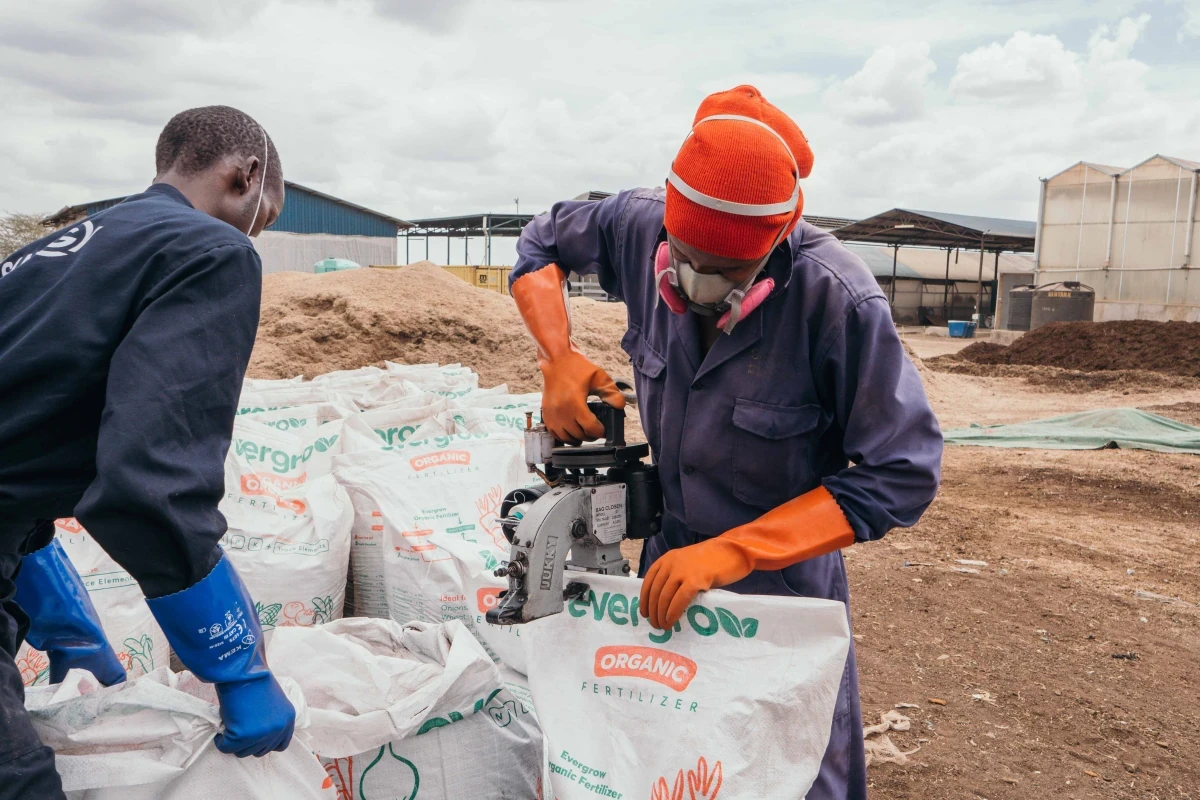
Evergrow is Regen Organics' nutrient-rich organic fertilizer, made from agricultural, animal, and municipal organic waste and broken down through thermophilic co-composting using windrows. Feedstocks pass through mesophilic and thermophilic phases (the thermophilic stage running roughly 40–65°C), which eliminates pathogens and concentrates nutrients. Per Regen Organics' own confirmed specification, the finished product is KEBS-certified and independently laboratory-tested under ISO-certified processes, with a nutrient profile of 1% nitrogen, 1% phosphorus, 1% potassium, 5% calcium, 12% carbon, and 20% organic matter, at a pH of 6.5–8.5. It is positioned as a complement to inorganic fertilizer rather than a wholesale replacement, aimed at rebuilding soil health while farmers continue much of their existing practice.
1
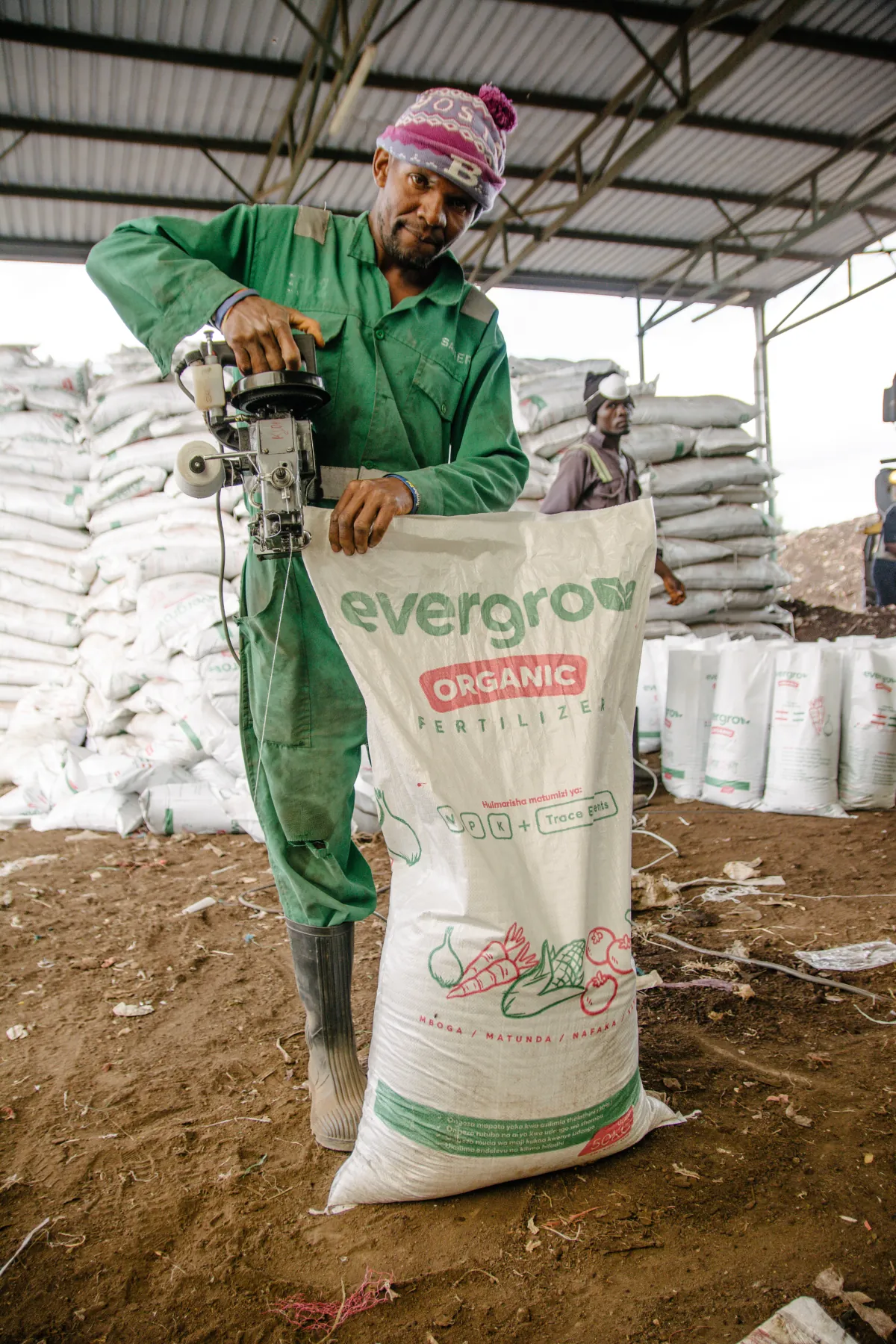
Waste is collected from sanitation systems, households, markets, and businesses, and sorted to remove plastics, metals, and other contaminants.
2
Feedstock is composted through thermophilic windrow composting for approximately four to six months, breaking down raw material and eliminating pathogens.
3
The finished compost is tested and certified (KEBS certification for standard Evergrow; ECOCERT for the Evergrow Gold export line).
4
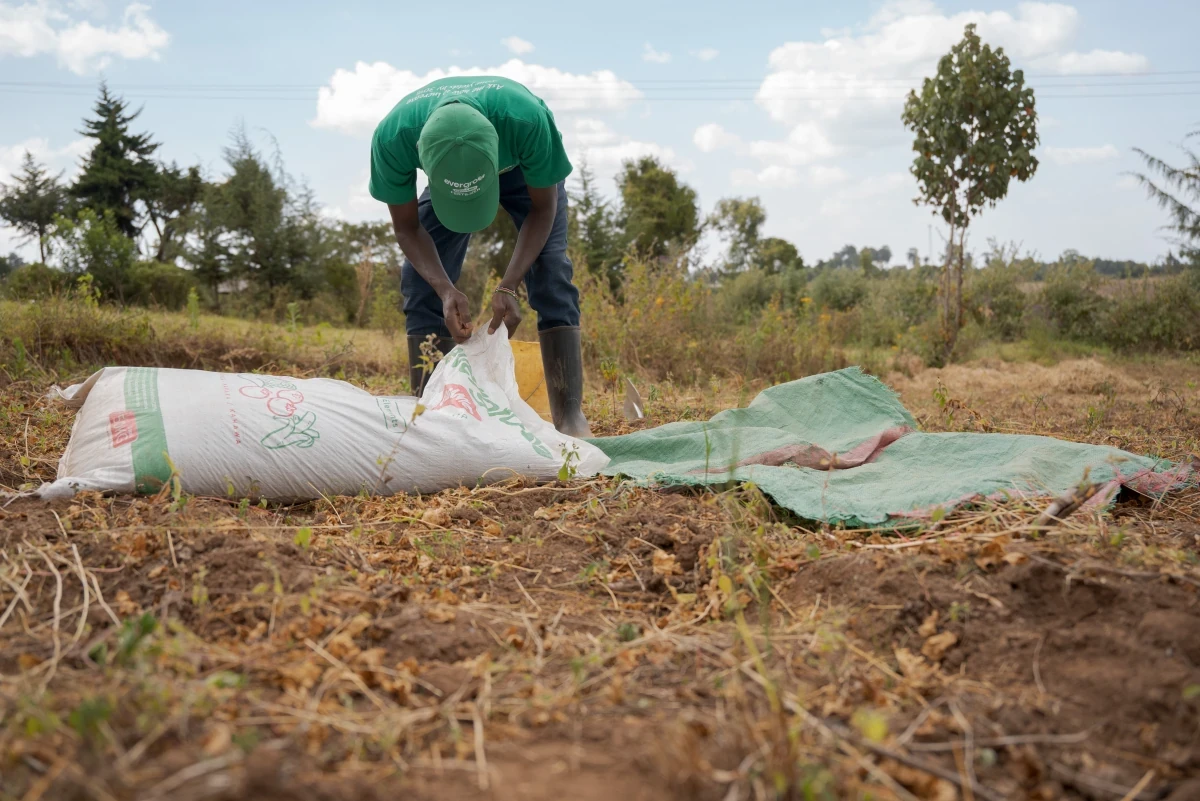
Farmers apply Evergrow as a basal or in-row dressing at a recommended rate of 500kg per acre (1.3 metric tonnes per hectare), adjusted to soil test and crop needs.
5
Most farmers pair Evergrow with their existing inorganic fertilizer rather than replacing it outright, at least initially.
Required Implementation Resources
Input cost: Evergrow retails at KSh 2,500 per 50kg bag (roughly $19 at ~129 KSh/USD).
Labor: standard application labor comparable to conventional fertilizer — no specialized equipment is required.
Financing: farmers currently bear the full cost themselves; a county-level voucher pilot in Kakamega is testing a subsidy model, with results pending.
Storage: Regen Organics confirms the product does not degrade quickly once a bag is opened.
Instructional videos
▶
Evergrow Planting guide - Potatoes
▶
Evergrow Planting guide - Avocado
▶
Evergrow Chilli B-roll
▶
Evergrow Potatoes B-roll
Practice Delivery
Organizational Role
Regen Organics manufactures Evergrow and distributes it through a subsidiary, Farmstar, which combines 13 directly employed agents with a much larger recruited network of over 500 agro-dealers and resellers, plus roughly 60 government-employed NCPB agents. The company also plays an upstream input-sourcing role: sanitation waste is collected by sister company Fresh Life, which operates in informal settlements in Kenya (and, for sanitation collection specifically, in Zambia), while other organic waste — from hotels, abattoirs, markets, and households — is sourced by a Regen Organics department called City Fresh, which coordinates with waste collectors and transport partners to deliver material to processing facilities. Regen Organics also partners with K+S, an established mineral fertilizer company, to help push the product to market, and works with NCPB to stock Evergrow at government depots, with payment for those sales channeled directly from government to Regen Organics.
Farmer Engagement and Training Strategy
Regen Organics reports that approximately 60% of farmers receive training via direct groups, and also engages farmers through NCPB agents (paid a commission on sales and farm visits) and farmer cooperatives. A 60 Decibels survey of 287 Evergrow users breaks down how farmers say they actually received training or information:
Visit from an Evergrow representative — 62%
"Bring a friend" event — 29%
Farm demonstration by Evergrow — 19%
Call from an Evergrow representative — 11%
Evergrow stand at a farmers' market — 7%
Radio and SMS from Evergrow — 5% each; Evergrow content on social media — 3%
92% of surveyed farmers report being satisfied or very satisfied with the training or information they received, and two-thirds (67%) say they apply all of it to their farming.
Gender and Social Equity Integration
Regen Organics reports that 47% of Evergrow users are women. The company says it deliberately promotes the practice to both male and female customers, recognizing that while farms are often formally owned by men, women frequently make the day-to-day farming decisions — so Regen Organics tries to ensure women are part of that conversation even where they are not the registered landowner.
Enabling Conditions
Key Enabling Conditions
Proximity to a distribution network: adoption is strongest where farmers are within reasonable reach of the agro-dealer and Farmstar network, since transport cost is a real barrier for a bulky organic input.
Regulatory credibility: KEBS certification lets Evergrow compete against unregulated organic products and gives agro-dealers and farmers confidence in a consistent, pathogen-free product.
A functioning distribution and extension network: direct visits and farm demonstrations are the highest-satisfaction adoption channel, so field staff on the ground matter as much as shelf space.
An independent evidence base: in a market where most competing organic products have no data behind them, Regen Organics points to its three independent evaluations as what turns a first purchase into a repeat one.
Land Tenure Dynamics and Impact on Adoption
99% of surveyed Evergrow users describe themselves as farm owners (60 Decibels, n=287), so lease-based cost-sharing between tenants and landowners is not a dynamic Regen Organics observes in this user base.
Results of Intervention

Environmental
Regen Organics' Kearney SROI evaluation cites 0.49 tonnes of CO2-equivalent avoided per tonne of waste processed, driven by displacing energy-intensive synthetic fertilizer manufacturing and by avoiding nitrogen runoff and associated emissions from over-application of inorganic fertilizer. 77% of surveyed farmers report a decrease in the occurrence of crop diseases or pests since starting Evergrow (60 Decibels).

Social
Of surveyed farmers, 96% report increased production (90% of whom attribute it to higher yield on the same land rather than farming more acreage), 84% report increased earnings (almost all — 99% — attributing that to a higher volume sold rather than higher prices or lower costs), and 92% report an improved quality of life. 42% have stopped using inorganic fertilizer entirely since adopting Evergrow, and 46% now use inorganic fertilizer alongside it rather than exclusively. 47% of users are women. Farmer satisfaction is high — a Net Promoter Score of 56, above the 60 Decibels East Africa agriculture benchmark of 40, with 61% of farmers classed as Promoters. 19% of surveyed farmers report experiencing a challenge with the product; within that smaller group, 32% (about 6% of all farmers surveyed) cite high price and 26% (about 5% of all farmers surveyed) cite poor farming outcomes. A separate analysis of 87 Evergrow users found self-reported yields 89% higher on average after adoption (median 43%) and self-reported revenue 217% higher on average (median 91%), while Kearney's SROI evaluation puts the average annual income increase at $1,486 for smallholder farmers (under 10 acres) and $7,361 for large farmers (over 10 acres) — though only 37% of that gain is attributed to Evergrow itself, with the remainder reflecting weather and price effects. All figures report year-on-year, self-reported increases.

Climate
See environmental outcomes above. Regen Organics also points to improved water retention in Evergrow-treated soils as a resilience benefit, though no separate quantified climate-resilience metric beyond the carbon figures was cited by Regen Organics.
Results Timeline
Effects on yield and production are typically visible within the same season or within a year of first use.
Outcome Variations
Kearney's SROI analysis segments outcomes by farm size: smallholder farmers (under 10 acres) see an average annual income increase of $1,486, while large farmers (over 10 acres) see $7,361. Small farmers make up the large majority of the sample (17,800 of roughly 18,000 farmers impacted) and capture an estimated 95% of the total additional income generated. No geography- or crop-level variation was reported by Regen Organics.
Formal Documentation of Outcomes
Three independent studies document Evergrow's outcomes: a Kearney Social Return on Investment (SROI) evaluation (September 2023), a 60 Decibels Impact Performance Report based on phone interviews with 287 Kenyan Evergrow customers (November 2023), and a Precision Development working paper on organic fertilizer in sub-Saharan Africa, which includes an Evergrow-specific appendix (June 2024, funded by Regen Organics).
What worked, and what changed
What Worked Well
Regen Practice Implementation Successes
Application itself is straightforward — Evergrow is applied much like conventional fertilizer and requires no specialized equipment. What has worked best from an adoption standpoint is the Farmstar distribution model, which reaches more than 10,000 farmers through a reseller/agro-dealer network of 500+, well beyond Regen Organics' 13 directly employed agents, giving Evergrow a physical presence at the point where farmers already buy their inputs.
Supply Chain and Systems-Level Successes
Pairing that retail footprint with direct representative visits and on-farm demonstrations is what Regen Organics credits with driving adoption, since farmers say they need to see the product working locally before they commit. Stocking Evergrow at NCPB government depots, with payment channeled directly from government to Regen Organics, has also expanded reach without Regen Organics having to build that distribution point itself.
Primary Drivers of Farmer Adoption
Direct representative visits and farm demonstrations are Regen Organics' highest-reach, highest-satisfaction adoption channel (62% of surveyed farmers were trained this way, with 92% satisfied or very satisfied). KEBS certification also gives Evergrow a credibility edge over unregulated competitors in a market where quality claims are otherwise hard to verify.
Effective Operational and Partnership Models
Partnerships with K+S (an established mineral fertilizer company) and with NCPB and county governments have been central to scaling distribution and to building credibility with both farmers and larger corporate buyers. Commissioning independent, credible impact evaluations has helped convert first purchases into repeat ones, in a market where most competing organic products lack comparable data.
Challenges & Pivots
Implementation Challenges
The most consistent theme in farmer feedback, in Regen Organics' own words, is price and pack size rather than the practice itself: Evergrow is sold only in 50kg sacks, which is both a cash-flow hurdle and more product than a small-plot farmer needs at once, and it competes at price parity against a subsidized inorganic alternative. Quantitatively, 19% of surveyed farmers report experiencing any challenge at all with the product; within that group, 32% (about 6% of all farmers) cite high price and 26% (about 5% of all farmers) cite poor farming outcomes, which Regen Organics attributes at least partly to factors like weather and application technique rather than the product itself.
Programmatic Pivots and Modifications
Regen Organics is actively considering smaller pack sizes and financing or pay-over-time options to address the cash-flow and pack-size issue, but has not yet implemented either. It has also considered, and so far avoided, letting agro-dealers break bags into smaller units informally, since that risks compromising certification integrity and the trust that KEBS certification is meant to provide.
Emerging Implementation Barriers
Last-mile availability — limited agro-dealer density and distribution points in some areas — remains an ongoing constraint, alongside the pack-size issue above.
Retrospective Adjustments
Regen Organics frames this less as "what we'd do differently" and more as an open, active area of work: smaller pack sizes and financing options are levers its sales and operations team is currently thinking through, which the company preferred to flag honestly rather than claim as already solved.
Economics & Financing
Implementation Organization Economics
Key financial metrics
Cost Per Hectare
~KSh 65,000
Cost-Share Arrangements
100% farmer
Intervention Financing and Capital Structure
Evergrow is currently financed entirely out of farmers' own pockets, with no national subsidy equivalent to the one available for inorganic fertilizer. Regen Organics is piloting a county-level voucher program with the Kakamega County government, intended to function as a subsidy for organic fertilizer; results were pending at the time of writing, and Regen Organics has agreed to share them once available.
Investor ROI Timeline
Regen Organics and its partners have not established a payback-period or J-curve timeline for investors in the way this question intends. The closest available measure is Kearney's Social Return on Investment (SROI) analysis: a $2.4 million investment is calculated to generate $46.2 million in adjusted incremental benefit — an undiscounted SROI of 19x (including an income multiplier for the long-term benefit of farmers spending additional income on education), falling to 13x once that education benefit is discounted for delayed realization (assuming the benefit is realized after 20 years, at a 5% discount rate), or 9.3x on a direct basis excluding indirect benefit. This is a ratio of social benefit generated per dollar invested, not a time-to-payback figure.
Farmer Economics
Net Income Impact and Percentage Gains Over Baseline
Kearney's SROI analysis finds an average annual income increase of $1,486 for smallholder farmers (under 10 acres) and $7,361 for large farmers (over 10 acres), of which only 37% is attributed to Evergrow specifically (the remainder reflects weather and price effects). Farmers' own self-reported figures, per Precision Development's analysis of the same underlying survey data, show an average revenue increase of 217% (median 91%) and an average yield increase of 89% (median 43%).
Drivers and Realization Timeline of Farmer Income Gains
The gains are driven primarily by higher yields from improved soil health, realized within the same season or within a year of first use. 99% of farmers who reported an earnings increase attribute it to a higher volume sold, rather than to higher prices (17%) or reduced input costs (21%).
Price Premiums, Yield Increases and/or Input Cost Reductions
Not materially, for either. Kearney's aggregate analysis found a net cost impact of roughly –$0.44 million in adjusted incremental benefit across the ~18,000 farmers assessed — in other words, farmers collectively pay more for fertilizer, not less, because Evergrow is used alongside rather than instead of other inputs. Rather than lowering costs or raising sale prices, Evergrow's value case rests on higher, more resilient yields, and on helping some farmers — particularly those growing coffee, tea, and other export or high-value crops — meet buyer quality and residue standards that unlock premium markets.
Reasons for Absence of Farmer Income Gains
Not applicable — farmers on average do see net income gains (see above), though the share attributable to Evergrow itself is smaller than the headline revenue figures suggest, and a minority of farmers (26% of the 19% who report any challenge, roughly 5% of all farmers surveyed) report poor farming outcomes, which Regen Organics links more to weather and application than to the product.
Scalability & Replicability
Enabling Conditions for Smallholder Scaling
A dense, physically proximate distribution network (to keep transport costs down for a bulky input); a recognized quality certification (KEBS, and ECOCERT for the export-oriented Evergrow Gold line); an independent evidence base; and some mechanism — subsidy, voucher, or financing — to offset the price gap with subsidized synthetic fertilizer.
Scaling Constraints
The absence of a national organic-fertilizer subsidy is the single biggest structural constraint, since it puts Evergrow in direct sticker-price competition with an inorganic product sold below cost. The 50kg-only pack size is a second, more solvable constraint on affordability and last-mile reach for very small farms.
Scaling Partnerships
K+S (co-distribution and blending), NCPB and the Kenya National Trading Corporation (government depot access and payment), the Kakamega County government (the voucher pilot), and the three independent evaluators — Kearney, Precision Development, and 60 Decibels — whose evidence underlies Regen Organics' credibility with both farmers and funders.
Key Risks
Primary Implementation Risks
Price sensitivity is the most exposed risk, worsened by direct competition with a subsidized synthetic product and by the possibility of further changes to the national fertilizer subsidy. There is also an attribution risk: only 37% of the income gains reported by Evergrow users are attributable to Evergrow itself once weather and price effects are accounted for, and Regen Organics is explicit that it must be careful not to overstate its own impact.
Data Gaps and Information Limitations
Independently measured soil-health data specific to Evergrow
Confirmation of the KEBS certification date
City Fresh’s waste-sourcing reflections
Reconciliation of two different published nutrient specifications for Evergrow
A precise timeframe for the reported “2.5x growth” in NCPB sales
Priorities for Testing and Validation for Replication
Whether smaller pack sizes and/or financing options meaningfully shift adoption among very small-plot farmers, and whether county-level voucher or subsidy pilots (like Kakamega's) can be replicated elsewhere in the absence of a national organic subsidy. Any inorganic-fertilizer cost comparison used for a business case should be independently verified rather than taken from a single organization's own approximation.
Farmer Perspective
“
The productivity has become greater since I started using [Evergrow] fertilizer, and I am able to sell the crops at a good price and get more income. Through this income, I manage to provide the livelihood of my family.
Participating farmer, 60 Decibels survey
“
They should improve on the quality of the [Evergrow] fertilizer. It should be designed in a way that it can support plants even when there is too much rainfall.
Participating farmer, 60 Decibels survey
“
The [Evergrow] fertilizer is hard to find. The fact that it is also only sold in a 50kgs sack makes it hard to buy especially when I have only planted and cultivated a small portion of my farm.
Participating farmer, 60 Decibels survey
“
The productivity has become greater since I started using [Evergrow] fertilizer, and I am able to sell the crops at a good price and get more income. Through this income, I manage to provide the livelihood of my family.
Participating farmer, 60 Decibels survey
“
They should improve on the quality of the [Evergrow] fertilizer. It should be designed in a way that it can support plants even when there is too much rainfall.
Participating farmer, 60 Decibels survey
“
The [Evergrow] fertilizer is hard to find. The fact that it is also only sold in a 50kgs sack makes it hard to buy especially when I have only planted and cultivated a small portion of my farm.
Participating farmer, 60 Decibels survey
“
The productivity has become greater since I started using [Evergrow] fertilizer, and I am able to sell the crops at a good price and get more income. Through this income, I manage to provide the livelihood of my family.
Participating farmer, 60 Decibels survey
“
The [Evergrow] fertilizer is hard to find. The fact that it is also only sold in a 50kgs sack makes it hard to buy especially when I have only planted and cultivated a small portion of my farm.
Participating farmer, 60 Decibels survey
“
They should improve on the quality of the [Evergrow] fertilizer. It should be designed in a way that it can support plants even when there is too much rainfall.
Participating farmer, 60 Decibels survey
On how farmers describe changes since adopting: 42% report having stopped using inorganic fertilizer entirely, while 46% now use it alongside Evergrow rather than exclusively. Two-thirds (67%) of surveyed farmers report applying all of the training information they received to their own farming, and 61% are Net Promoter “Promoters” who say they would actively recommend Evergrow to others.
Resources & Media
Regen Organics 2025 Impact Report
PDF · Farmer testimonials, quotes, photographs and video.
Videos
▶
Evergrow Farmer_Regina
▶
Evergrow Farmer _Patricia Njoroge
▶
Evergrow Farmer_Paul Kimani
Gallery
More case studies.
More case studies.
Regenerative and climate-smart practices, direct from practitioners working with smallholders.
Regenerative and climate-smart practices,
direct from practitioners working with smallholders.
Regenerative and climate-smart practices, direct from practitioners working with smallholders.

See case study
→
Manual Pump Irrigation
KickStart International helps smallholder farmers across Sub-Saharan Africa irrigate high-value crops year-round with its fuel-free MoneyMaker manual pumps.
Sub-Saharan Africa
Horticulture Crops
Increased Farmer Income

See case study
→
Super Pearl Fish Amino Acid Fertilizer
Proximity Designs brings Super Pearl, a locally fermented fish amino acid liquid fertilizer, to smallholder farmers in Myanmar as an affordable alternative to synthetic nitrogen fertilizer.
Myanmar
Grains & Cereals
Increased Farmer Income

© 2026 CASH Coalition
All rights reserved.
Climate Action for Smallholders (CASH) Coalition Inc. is registered as a 501(c)(3) organization in the United States.
© 2026 CASH Coalition
All rights reserved.
Climate Action for Smallholders (CASH) Coalition Inc. is registered as a 501(c)(3) organization in the United States.
© 2026 CASH Coalition
All rights reserved.
Climate Action for Smallholders (CASH) Coalition Inc. is registered as a 501(c)(3) organization in the United States.